
Here's your AI Search Optimization Checklist
The winners in AI search are not the sites with the best content, but the organizations that publish the most trustworthy, original, and easily cited information.
Charles Warnock
6/2/20262 min read
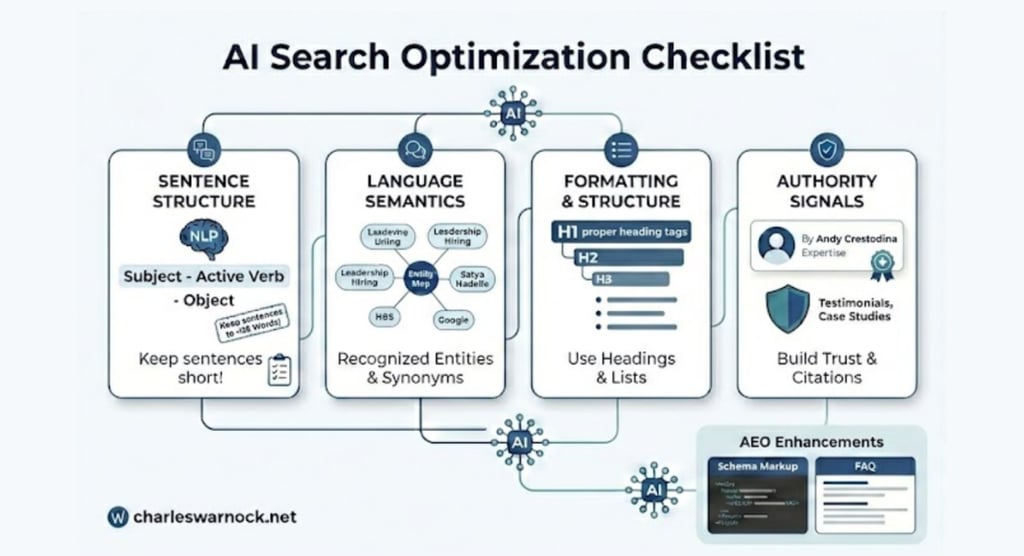
AI Search Optimization Checklist
What kind of content wins AI citations?
In citations, Google, OpenAI, Anthropic, and Perplexity increasingly seem to prioritize content containing:
Specific facts, verifiable over multiple sources
Content that’s unique to your brand
Original research and observations
Clear attribution to reputable sources
Surveys, case studies, statistics
Named entities (company, product, executives, locations) over keywords
Strong POVs and declarative statements
That means optimizing for the ecosystem beyond your website is more important than ever. Push to expand your content on guest articles, podcasts, industry publicatons, interviews, research reports and event appearances.
Optimizing for Google AI Overviews, ChatGPT, Perplexity, Bing Copilot, and other AI-powered search
About 37% of consumers now start searches with AI tools like Claude, Gemini or ChatGPT rather than traditional search engines, according to Search Engine Land.
AI-powered searches outperform traditional searches in conversion actions.
AI doesn't just crawl your content—it summarizes it, extracts individual sentences, and presents them as direct answers.
This checklist is designed to help you structure content so AI platforms can understand, quote, and cite it effectively.
🔹 1. Sentence Structure: Make It AI-Friendly
Start each key sentence with a clear subject (the person, place, thing or idea)
Example: “Our executive search team identifies senior talent.”Use an active verb (avoid passive voice)
Example: “We assess leaders,” not “Leaders are assessed.”Include a specific object or modifier
Example: “for real estate finance firms,” “across the Southeast,” etc.Keep sentences under 25 words for clarity and summarization
🔹 2. Language Semantics: Match AI & User Intent
Use natural language, not keyword stuffing. That is so 1990s.
Bad: “CMA executive search hiring firm leadership real estate”
Good: “CMA specializes in leadership hiring for real estate companies.”Include related terms and synonyms (semantic variants)
Example: “C-suite,” “executive talent,” “leadership roles,” “senior hiring”Mention entities that AI models recognize (people, companies, locations, job titles)
Write declarative, standalone sentences that can be pulled as AI citation.
🔹3. Formatting & Structure: Help AI Understand Hierarchy
Use proper heading tags (H1, H2, H3)
Example: H2 = “Operational Reviews” / H3 = “How They Work”Break ideas into short paragraphs (2–3 sentences max)
Use bulleted lists for benefits, features, or steps
Include internal links to related topics or service pages
Use anchor text that’s descriptive (not just “click here”)
🔹 4. Authority & Trust Signals (for E-E-A-T* & AI Citation)
Add author bylines with name + credentials
Example: “By Andy Crestodina, CMO and Co-Founder at Orbit Media Studios”Include testimonials, case studies, or data-backed outcomes
Mention years of experience, industry affiliations, or awards
Display a physical address, phone number, and email (trust indicators)
*(Experience, Expertise, Authoritativeness, and Trustworthiness)
🔹 5. Answer Engine Optimization (AEO) enhancements to consider
Use schema markup for FAQs, Services Pages. Delegate this to your fav AI tool.
Include FAQs or answer-style content
Add a “Who We Help” or “Industries Served” section
SEO & AI Search: Better Together
There are many actions you can take to boost your content’s visibility for both search engines and AI-powered searches.
Writing with a clear Natural Language Processing (NLP) structure helps your site get quoted, featured, and trusted by AI search engines.
About 37% of consumers now start their searches with AI tools like Google Gemini or ChatGPT rather than traditional keyword search engines. Search Engine Land
AI searches are rapidly growing and outperform traditional searches in conversion actions.
AI search doesn’t just crawl content — it summarizes it, as in Google AI overviews.
Write complete thoughts in single sentences that make sense without the surrounding context. AI platforms extract individual sentences and present them as answers.
Charles Warnock | cw@charleswarnock.net |Portfolio |LinkedIn | 408.334.5979
